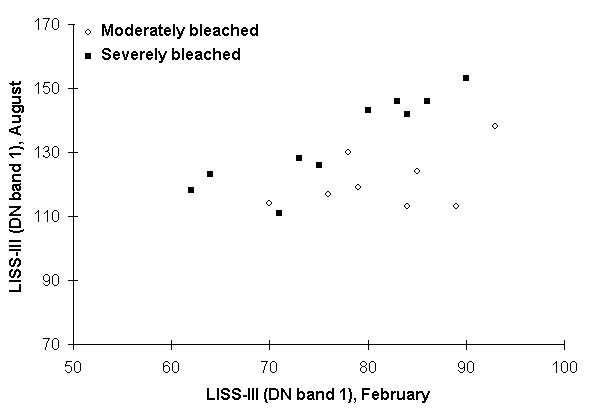
Recent dramatic bleaching events on coral reefs have enhanced the need for global environmental monitoring. We have investigated the value of present high spatial resolution satellites to detect coral bleaching using a change detection technique. We compared an IRS LISS-III image taken during the 1998 bleaching event in Belize to images taken before the bleaching event. The sensitivity of the sensors was investigated and a simulation was made to estimate the effect of sub-pixel changes. A manual interpretation of coral bleaching, based on differences between the images, was performed and the outcome was compared to field observations. The spectral characteristics of the pixels corresponding to the field observations and the manually interpreted bleachings have been analysed and compared to pixels from unaffected areas.
Our calculations have shown that it should be possible to detect bleaching in
imagery from existing high resolution satellites, even if we use only the
system corrected digital counts. Several possible "bleaching areas", which
correspond to shallow coral reef zones were found in the LISS-III imagery from
Belize in August 1998 by manual interpretation and almost all image data
corresponding to the manually interpreted bleaching showed increased DN values
in August 1998 compared to unaffected areas Fig. 1. Although the ability to use remotely sensed imagery to detect
bleaching events is hampered by the transient nature of bleaching and the rapid
rate at which the spectral signature changes on a reef once bleached corals die,
we are confident that the technique could be used for rapid assessment of the
extent and severity of bleaching on reefs. With new high resolution satellites
already in orbit our ability to remotely detect changes on reefs should improve.
(Please see our Buenos Aires Paper)
A paper on this subject was presented in Bali, October 2000.
Publications
Fig. 1 Pixels from moderately and severely bleached locations.